
Alberta Limb Osseointegration Program
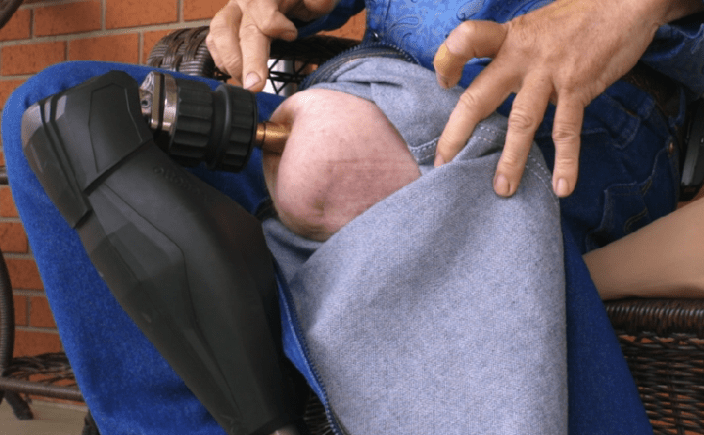
Limb osseointegration is an innovative new technique to attach prosthetic components directly to the skeleton of the remaining limb of a person with limb amputation, bypassing the need for a prosthetic socket. Osseointegration is indicated for individuals with limb amputation who cannot tolerate or use a traditional prosthesis. A bone-anchored prosthesis has a more secure attachment; the prosthesis can be worn for extended periods and easily taken on and off as needed. People with bone-anchored prostheses report improved movement, quality of life, and awareness of the position of the prosthesis.
The osseointegration procedure is an accepted clinical procedure used for limb amputation throughout Europe and Australia for over two decades. Since 2020, osseointegration for lower limbs has been performed in Edmonton at the University of Alberta Hospital (UAH), supported by the University Hospital Foundation. The multi-disciplinary team includes UAH surgeons Dr. Robert Stiegelmar, Hollie Power, and Adil Ladak, with physiatrists Dr. Heather Lindstrom and Jacqueline Hebert. Following surgery, rehabilitation occurs at the Glenrose Rehabilitation Hospital, Canada’s largest free-standing, comprehensive tertiary rehabilitation hospital. The innovation of the surgical procedure, the refined rehabilitation protocol and the establishment of a comprehensive research program around osseointegration will advance the field and improve the lives of persons with limb amputation.
Lower-limb osseointegration participant stories
Research studies on osseointegration
BLINC Lab PI Dr. Jacqueline Hebert has created a research program to advance knowledge in the field of osseointegration. She leads research studies aimed at better understanding the various aspects and impact of osseointegration.
Tracking outcomes of lower-limb osseointegration (Funded by the University Hospital Foundation)
This study involves comprehensive tracking of clinical and functional outcomes, and complications for 2 years following surgery, which enables the comparison of the individual patient’s outcomes pre- and post-surgery and the tracking of complications. Quality of life outcomes are collected up to 10 years after the osseointegration surgery.
Evaluation of gait patterns following osseointegration
We are assessing the gait (walking pattern) of patients after Osseointegration surgery compared to how they walked with a socket prosthesis prior to OI. Using instrumented gait analysis (at the Syncrude Centre for Motion and Balance, Glenrose Rehabilitation Hospital), we will determine if OI surgery improves walking patterns, which may result in reduced long-term complications (such as muscle and joint problems).
Exploring lived experiences and rehabilitation journeys of individuals receiving osseointegration prostheses (Funded by the Glenrose Rehabilitation Hospital Foundation)
To complement these comprehensive assessments, another study explores the lived experience of those who undergo osseointegration using qualitative research methods. This study captures the subjective experience and personal perceptions on the aspects of health that have changed after osseointegration.
Evaluation of Transfemoral OI Implant Stability (OI ASIST) (Funded by The Congressionally Directed Medical Research Programs, Department of Defense; FY20 Peer Reviewed Orthopaedic Research Program; Award No. W81XWH-20-PRORP-CTRA)
In partnership with Co-I Lindsey Westover in the Department of Mechanical Engineering at the University of Alberta, Dr. Hebert leads a study that aims to develop and refine a novel device called Advanced System for Implant Stability Testing (ASIST) to assess implant stability in the bone post-surgery through evaluating the vibratory response of the metal implant. The goal of this study is to enable researchers to detect implant stability and assist clinicians in the early detection of implant loosening and failure.
Optimizing Transhumeral Osseointegration Prosthesis Control (Funded by The Congressionally Directed Medical Research Programs, Department of Defense; FY22 Peer Reviewed Orthopaedic Research Program; Award No. W81XWH-22-PRORP-CTRA)
This study combines our multi-disciplinary expertise in neural reinnervation, myoelectric training, and upper limb prosthesis control to implement effective multi-degree of freedom prosthesis control with osseointegration for transhumeral amputation. The co-investigators include Drs. Hollie Power, Adil Ladik, and Robert Stiegelmar (Department of Surgery), as well as Drs. Patrick Pilarski and Ahmed Shehata. The project will develop a high-performance novel control strategy to improve prosthetic function after transhumeral osseointegration and provide state-of-the-art rehabilitation processes to effectively translate these techniques into the clinical space. After osseointegration and targeted muscle reinnervation, each participant will receive a myoelectric prosthesis and intensive training on using the new advanced prosthesis. We will measure the change in their function over time through various assessments of function. We will assess if this new system will improve the use of the prosthesis in daily life and result in better satisfaction with the prosthesis.
List of publications/abstracts/presentations by the BLINC Lab
Publications
Mohamed M, Beaudry E, Shehata AW, Raboud D, Hebert JS, Westover L. (2024). Evaluation of the Transfemoral Bone–Implant Interface Properties Using Vibration Analysis. Annals of Biomedical Engineering. 52: 2987–3008.
DOI: https://doi.org/10.1007/s10439-024-03561-6
Rehani M, Stafinski T, Round J, Jones CA, Hebert JS. (2024). Bone-anchored prostheses for transfemoral amputation: a systematic review of outcomes, complications, patient experiences, and cost-effectiveness. Frontiers in Rehabilitation Sciences. 5:1336042. DOI: https://doi.org/10.3389/fresc.2024.1336042
Ravari R, Rehani M, Hebert JS. (2023). Biomechanical characteristics of transfemoral bone-anchored prostheses during gait: A review of literature. Prosthetics and Orthotics International. 48(4):412-421. DOI: https://doi.org/10.1097/PXR.0000000000000263.
Hebert JS, Rehani M, Stiegelmar R. (2017). Osseointegration for Lower-Limb Amputation: A Systematic Review of Clinical Outcomes. JBJS Reviews. 5(10): e10. DOI: http://dx.doi.org/10.2106/JBJS.RVW.17.00037.
Abstracts
Mohamed M, Beaudry E, Brenneis D, Hebert JS, Westover L. (2024). Evaluating the independence of
a vibrations based stability measurement method for transfemoral implants from the system’s geometry. Progress in Canadian Society for Biomechanics Biennial Conference. Canadian Society for Biomechanics Biennial Conference. https://csb-scb.com/wp-content/uploads/2019/04/CSB2018_20th_Abstracts.pdf
Beaudry E, Mohamed M, Hebert JS, Westover L. (2023). Design of a Handheld Impactor for Transfemoral Osseointegrated Implant Stability Assessment. Progress in Faculty of Engineering Graduate Research Symposium. University of Alberta Faculty of Engineering Graduate Research Symposium.
Rehani M, Jones CA, Round J, Hebert JS. (2022). Exploring health-related quality of life with bone-anchored prostheses in persons with transfemoral amputation [Abstract]. In 29th Annual Conference of the International Society for Quality of Life Research. Quality of Life Research. 31(Suppl. 2): S125-S126. https://link.springer.com/article/10.1007/s11136-022-03257-1
Mohamed M, Raboud D, Hebert JS, Westover L. (2022). Stability Assessment of Osseointegrated Transfemoral Bone-Implant Systems using Finite Element Modal Analysis. Proceedings of the Canadian Society for Mechanical Engineering International Congress. Canadian Society for Mechanical Engineering International Congress.
Ravari R, Lewicke J, Hebert JS. (2021). Biomechanical Characteristics of Transfemoral Prosthetic Gait Before and After Osseointegration Surgery. Prosthetics and Orthotics International: Digital Transformation in an Evolving World.
 BLINC Lab